How to track your child's progress in therapy (free progress planner)

Short answerTo know if therapy is working, pick 1 to 3 clear goals, write down where your child is today, and check the same thing at home every week. A tally out of 5 tries, a timer, or a 1-minute video once a month is enough. Every 3 months, compare today with the start and talk it through with the therapist. Our free 10-page Progress Planner has every page you need.
This guide is written for parents of autistic children and children with ADHD, speech delay or other developmental needs.
It comes from the TimeNinja team, not from a therapist. It will help you ask better questions. It does not replace your child's therapist, doctor or school team.
Why track your child's progress?
Therapy takes a lot of time, money and hope. Yet when someone asks "Is it helping?", most of us answer with a feeling. Tracking turns that feeling into something you can see.
- Memory is unreliable when you're tired. After a hard night or a hard week, it can feel like nothing has changed. A notebook remembers the good days too.
- Small progress is easy to miss. You see your child every day, so change feels slow and quiet. Going from 1 out of 5 to 3 out of 5 is real progress. You only notice it if you wrote down the 1.
- It turns meetings into a conversation with facts. "She asked for help 3 times this week, and 0 times in September" leads to a better talk than "I think she's a bit better?"
- It shows early if something isn't working. If nothing moves for 3 months, you can ask why now. Not after a year of fees.
This is more than common sense. Researchers call it measurement-based care, or routine outcome monitoring.
In a randomized trial with 340 young people getting mental health care at home, those whose clinicians got weekly progress feedback improved faster than those whose clinicians got it every 90 days (Bickman et al., 2011).
A review of 24 studies, mostly in adult talk therapy, found that regular progress feedback cut the rate of people getting worse. For people who were going off track, it nearly doubled the rate of real improvement (Lambert et al., 2018).
Speech and language therapy works the same way. ASHA, the US professional body for speech-language pathologists, says good decisions combine three things: research, data and observations collected on your child, and the family's own values and priorities (ASHA).
Your notes from home are part of that data.
You are also part of the team. The NCAEP review of autism research lists parent-implemented intervention among its 28 evidence-based practices (NCAEP, 2020).
The World Health Organization's Caregiver Skills Training is built on the same idea. It teaches families of children aged 2 to 9 to use everyday play, home activities and routines as chances to learn (WHO).
Tracking protects your child and your money. Your notes show when a method upsets your child or isn't helping. Then you can decide about more sessions, fewer sessions or a different therapist with facts.

How to set a good goal
A good goal is something your child will do that makes daily life easier or happier for them. It should pass three tests.
- Measurable. You can count it, time it, or see it on a video. "Improve speech" is not measurable. "Asks for more at snack time in 4 out of 5 chances" is.
- From your child's point of view. Ask yourself: does this help my child do something they want or need? Asking for a break helps your child. Sitting still for an hour mostly helps the adults.
- Strengths-based. Start from what your child already does and loves. A child who loves trains may learn "go", "stop" and "more" fastest in a train game.
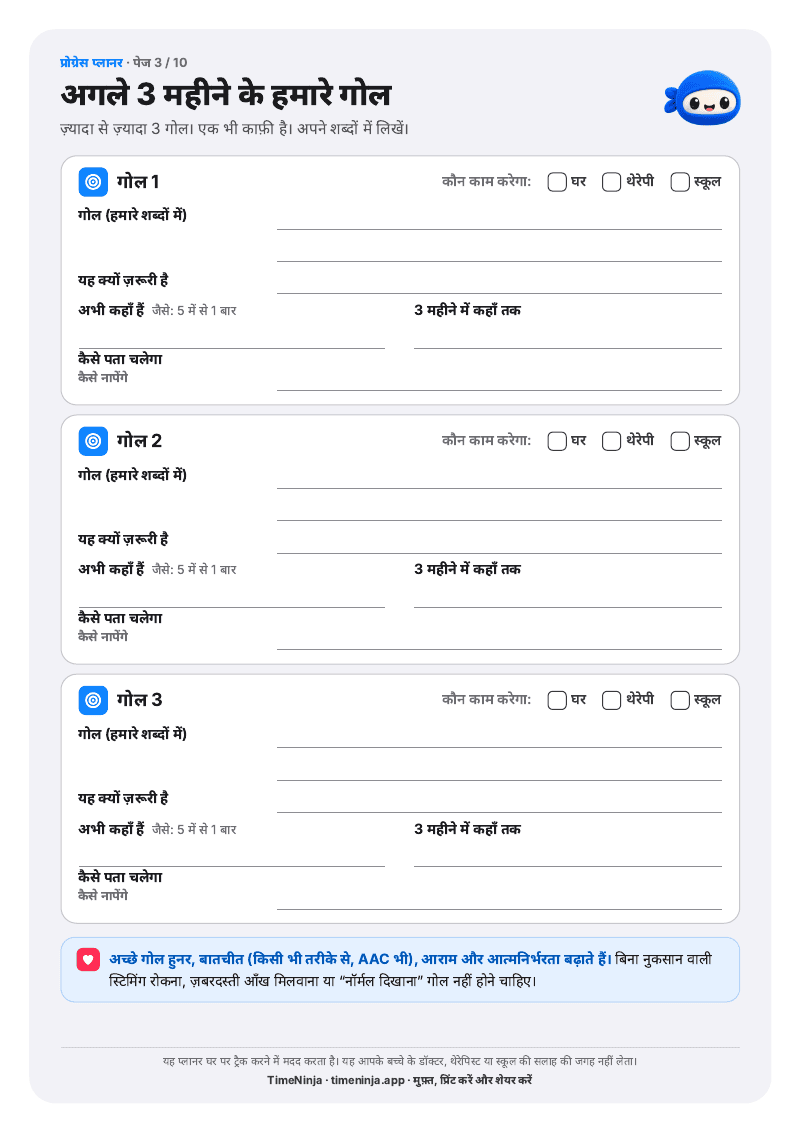
For each goal, write three things: where your child is today (the baseline), what you hope for in about 3 months (the target), and how you'll measure it.
Start with 1 to 3 goals. One goal you really track is worth more than ten you forget.

| Area | Vague goal | Measurable goal |
|---|---|---|
| Communication | "Better communication." | Asks for "more" at snack time with a word, sign or picture card, in 4 out of 5 chances, for 2 weeks in a row. |
| Daily routines | "More independent in the morning." | Does 3 of the 4 morning steps with only the picture chart as a reminder, on 4 of 5 school days. |
| Self-care | "Learn to get dressed." | Puts on a T-shirt and shorts with only a little help, on 4 out of 5 mornings. |
| Play | "Play better with others." | Takes 3 turns in a simple game with a parent or sibling, in 3 out of 4 games. |
| Sensory comfort | "Cope with noisy places." | Puts on ear defenders or asks for a quiet spot when a place gets too loud, in 3 out of 5 outings, with a little help. |
| Behavior and feelings | "Fewer meltdowns." | Shows a "break" card or says "stop" when upset, in 3 out of 5 chances, then goes to a calm spot. |
Goals we never recommend. Some goals try to make a child look less autistic or less ADHD. Skip goals to stop harmless stimming like hand-flapping or rocking. Skip goals to force eye contact, to "sit quietly" or to "look normal".
These goals mostly make adults more comfortable. They don't give your child a new skill. If a behavior is truly unsafe, like head-banging, work with your team on a safer way to meet the same need. Good goals add skills, comfort and choices.
Need ideas? Our free autism goal sheets have goal ideas by area, plus a small steps ladder to break a big goal into smaller ones.
How to measure progress at home (no special skills needed)
You don't need graphs or special training. You need the same small check, done the same way, often enough to see a pattern. Pick one or two of these for each goal. Aim for about 5 minutes, 2 or 3 times a week.
1. Take a baseline in week 1
Before anything changes, watch for one week and write down what happens now. If your child asks for "more" at 0 out of 5 snacks, write "0 out of 5".
That number is your starting line. Without it, you can't see how far you've come. Ask the therapist for their baseline from the first assessment too.
2. Count tries: a simple tally out of 5
Give your child 5 natural chances, like 5 snacks or 5 turns in a game. Mark a tick each time they do it. Three ticks out of 5 is "3 out of 5".
Use the same activity at about the same time of day, so the weeks compare fairly. A sheet on the fridge and a pen nearby is all you need.
3. Use a timer for minutes
Some goals are about time, like how long your child waits for a turn or stays at the table. Start a timer and write down the minutes. A visual timer also lets your child see how long is left.
4. Note how much help your child needed
Many skills grow in stages before your child does them alone. Use three simple levels:
- With help: you guide them through it, maybe hand over hand.
- A little help: a word, a point or a picture is enough.
- On their own: no help at all.
Moving from "with help" to "a little help" is progress, even if the tally stays the same.
5. Record a 1-minute video once a month
Once a month, film the same everyday activity, like snack time, in the same place, for 1 minute. After 3 months, watch the first video and the latest one side by side.
Videos catch things numbers miss: more sounds, more shared smiles, a calmer body, a new way of asking. Keep the videos private on your own phone. Don't post them in group chats or on social media. Show them to the therapist when it helps.

6. Add a sleep and health note
Write one line a week about sleep, illness, pain, teeth, medicine changes, or big events like a new school or visitors. A bad week often has a reason.
Children who regularly sleep less than they need are more likely to have attention, behavior and learning problems (AASM, 2016). A cold or an earache can throw off a week too.
Your note stops one hard week from looking like failure. If sleep is a struggle, our guide to sleep problems in kids with ADHD may help.
Home and therapy both count
Write down what you see at home, and ask the therapist what they see in sessions. A skill your child shows in the therapy room but not at home isn't finished yet.
Real progress shows up in daily life. If the two pictures are very different, talk about why.
How to use the free Progress Planner, page by page
The TimeNinja Progress Planner is a free 10-page printable PDF. Print it, keep it in a folder, and take it to every therapy meeting. Here's what each page is for.
- Cover and how to use. A quick guide to the whole planner, so anyone in the family can pick it up.
- My child at a glance. Your child's strengths, loves, what helps and what's hard. It also lists the team: names, contact details and registration numbers, so you can check each therapist's registration later.
- Our goals for the next 3 months. Up to 3 goals, each with its baseline, its target and how you'll measure it.
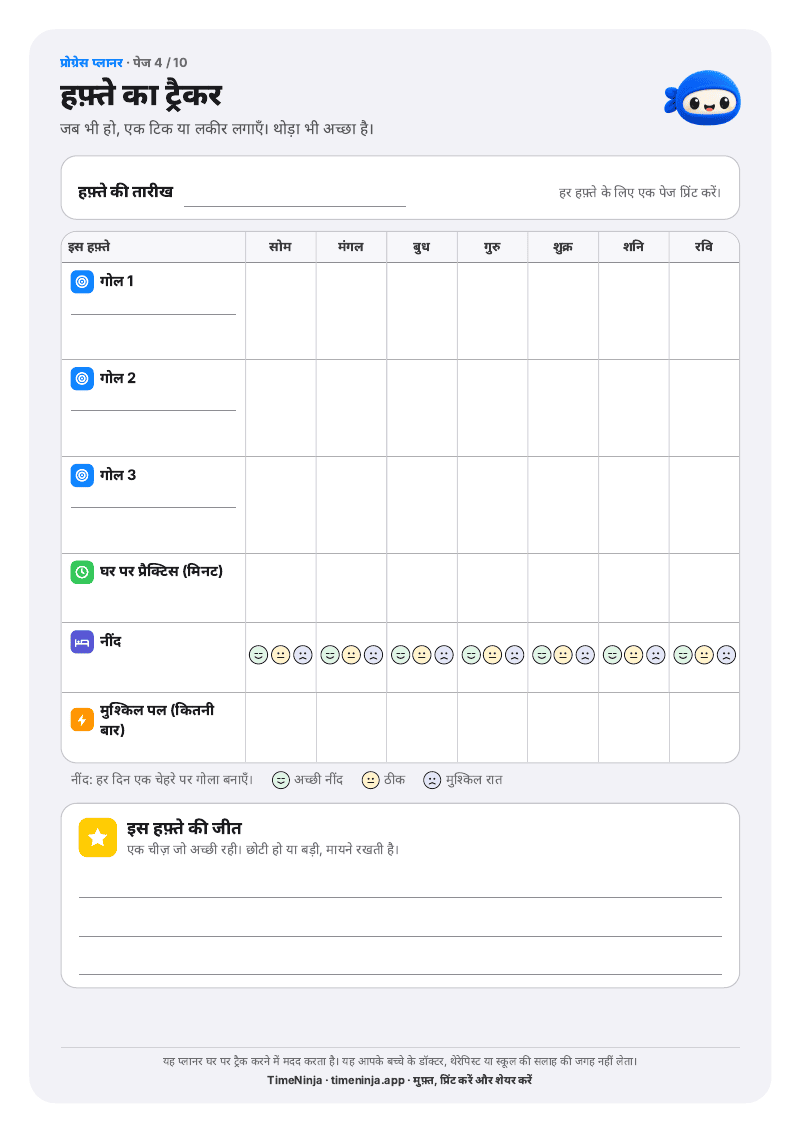
- Weekly tracker. Space for tallies, minutes or help levels through the week, plus your sleep and health note.
- Monthly review. What went well, what was hard, and what to change next month. A good place to note your 1-minute video.
- Therapy session log. The date, what they worked on, what to practice at home, and how your child seemed.
- 3-month progress review. The baseline next to today for each goal, so you can see the change at a glance.
- Questions to ask the therapist. Ready-made questions, plus space for your own.
- Fees and sessions log. Sessions booked, sessions attended, sessions missed, and what you paid.
- Celebrations. Small wins, first times and proud moments.
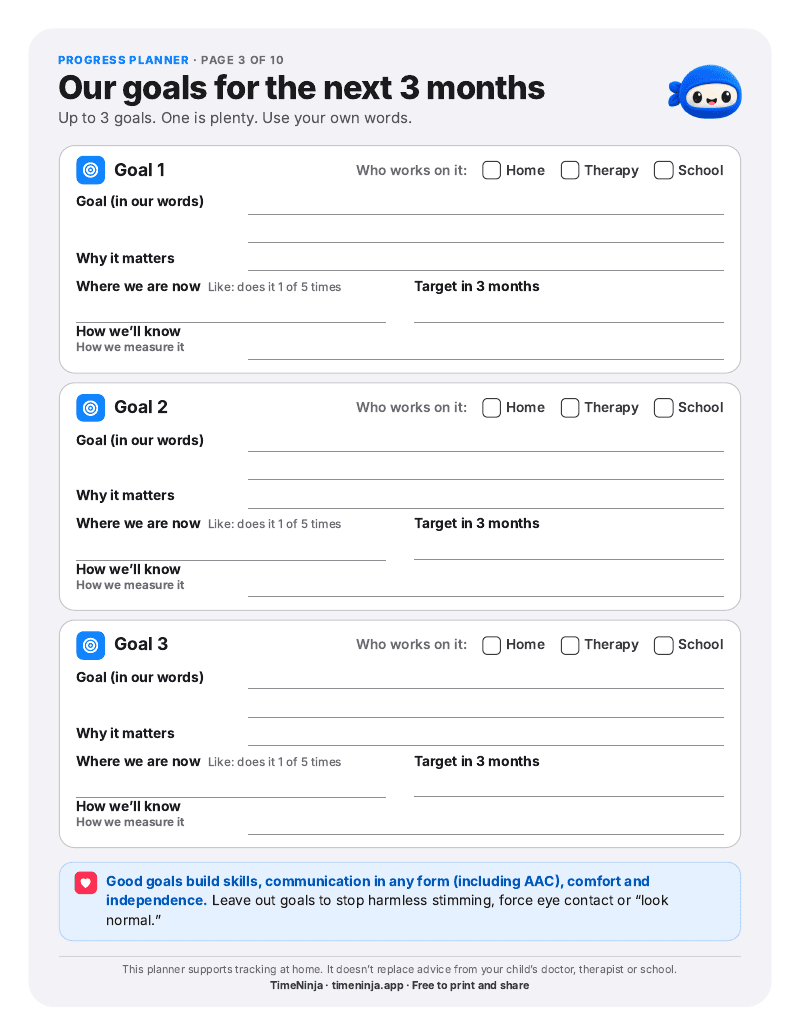
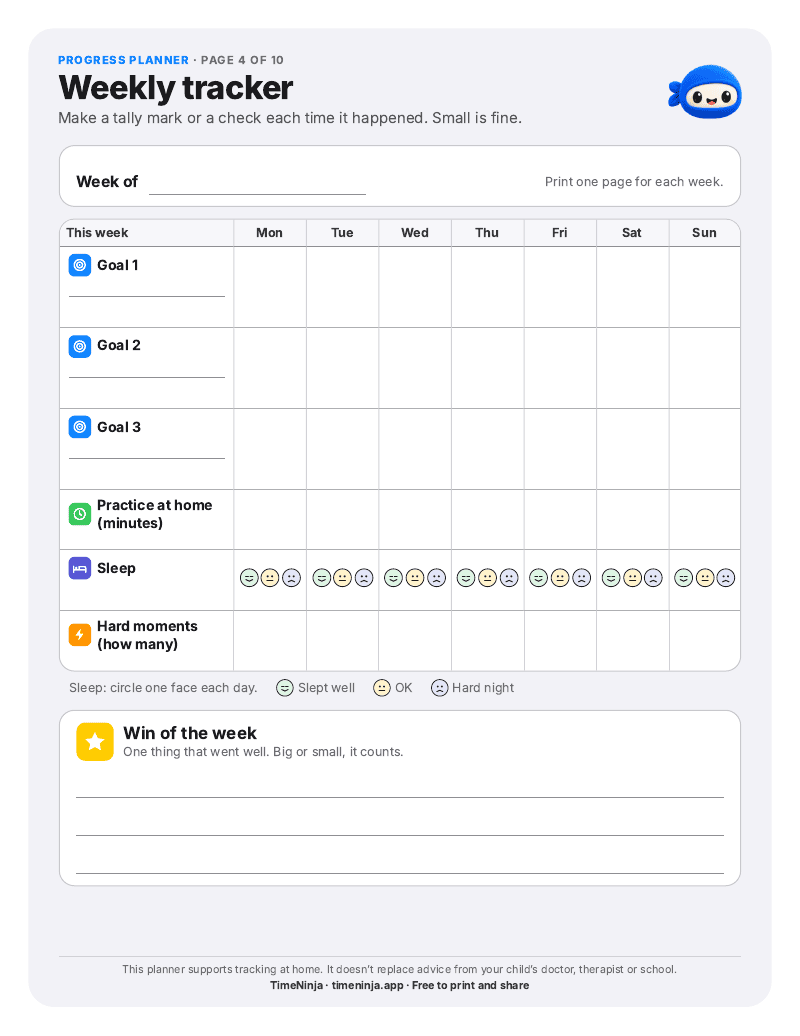
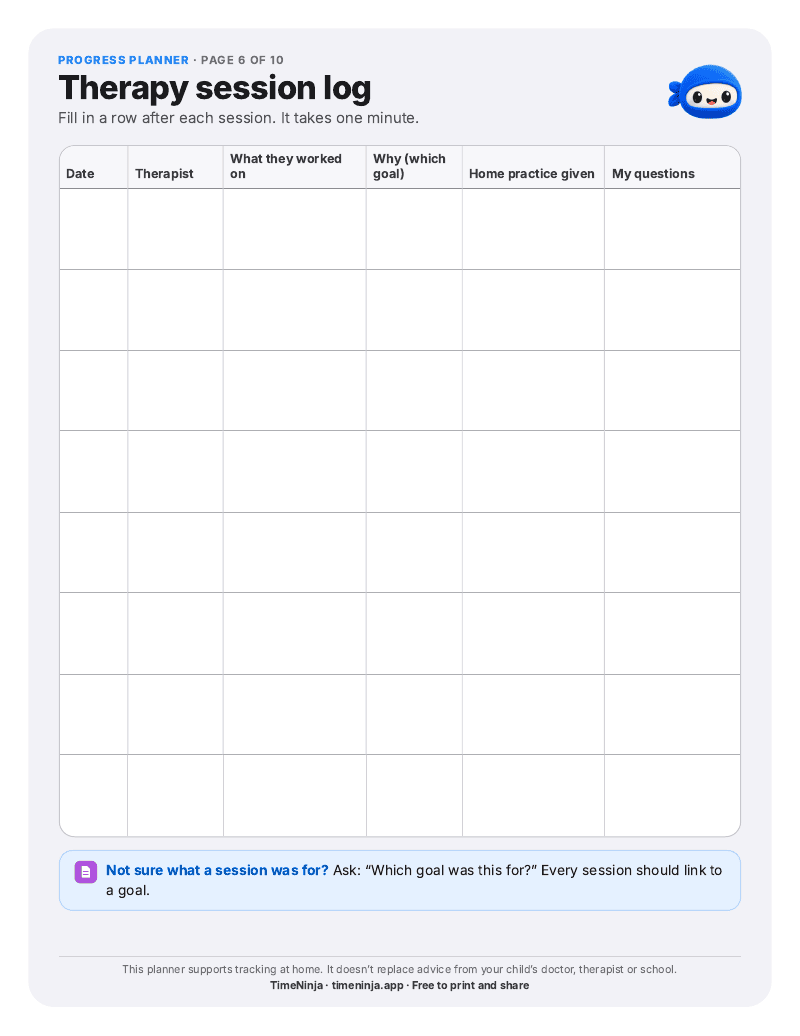
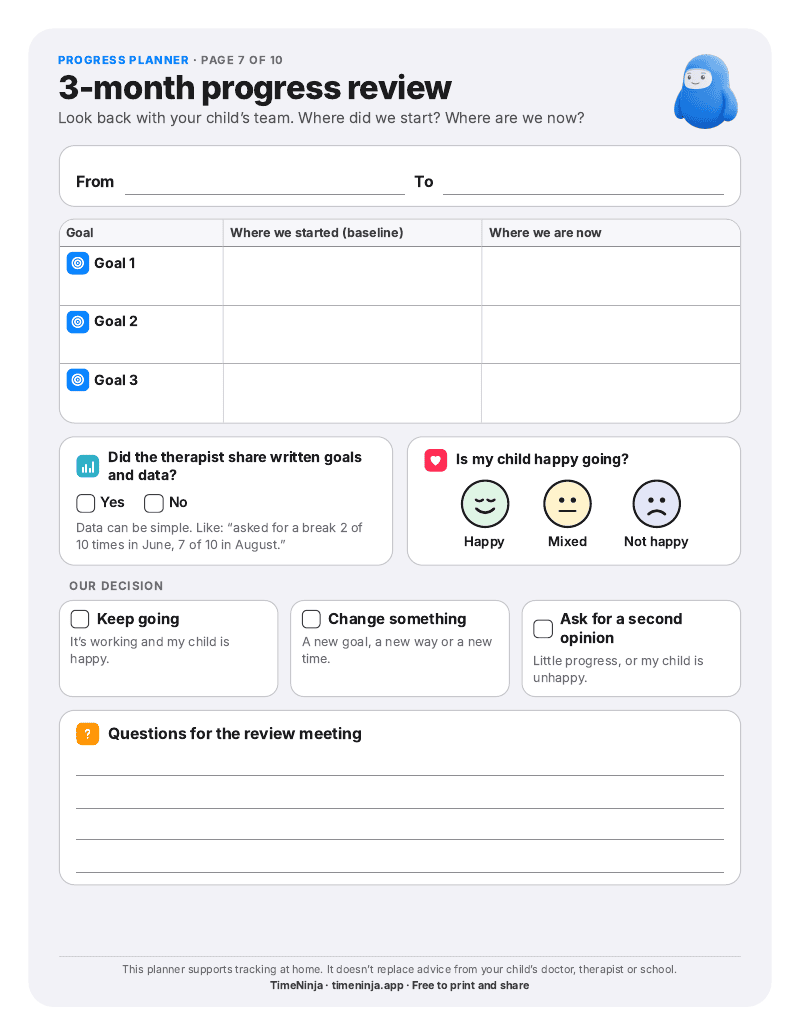
Print tips: the pages are US Letter. On A4 paper, choose “Fit to page” and nothing gets cut off. Print the weekly tracker and session log a few times, or slip them into a plastic sleeve and use a dry-erase pen.
Every 3 months: the progress review
Three months is long enough to see change and short enough to fix things early. In US schools, the law says every IEP must have measurable goals and regular progress reports, for example every quarter alongside report cards (34 CFR 300.320).
ASHA describes the same kind of regular reports, built on session data (ASHA). Your home review can follow this rhythm, wherever you live.
What progress looks like
- The numbers move up from the baseline, even slowly.
- Your child needs less help for the same thing.
- The skill shows up in a new place, or with a new person.
- Your child seems calmer or happier, and mostly wants to go to therapy.
What "no progress" might mean
If a goal hasn't moved in 3 months, don't blame yourself or your child. Look at these possible reasons, one at a time.
- The goal is wrong. It may be too big, too vague, or not important to your child. Make it smaller or change it.
- Too little practice. One session a week with no practice at home may not be enough. Ask for one small thing you can do every day.
- Health or life got in the way. Check your sleep and health notes for illness, pain, poor sleep or big changes.
- The approach doesn't fit your child. A method that suits many children may not suit yours.
- It's not the right therapist. A good therapist welcomes questions and changes the plan when the data says so.
What to ask at the review
- What was my child's baseline, and where are they now?
- Which goals are done, which are moving, and which are stuck?
- If a goal is stuck, what will you change?
- What should we practice at home next?
- When will we review again?
When to get a second opinion
Think about a second opinion if there are still no written goals or data after the first month or two. Or if a goal hasn't moved for 3 to 6 months and nothing in the plan has changed.
Also if your child is often scared or very upset before or after sessions, if you're kept out or told not to ask questions, or if someone promises a cure. A second opinion is not disloyal. It's normal care for your child.
For a full checklist, read is my child's therapist any good? For what the first months usually look like, see what to expect from your child's therapy.
If your child doesn't speak yet, what non-speaking children want parents to know covers signs of progress that don't need words.
Celebrate effort and small wins
Progress is not a straight line. Most children have good weeks and hard weeks. Plateaus are normal.
Sometimes a child's energy is going into something else, like a new school, a new sibling or a growth spurt. Look at the trend over months, not at one bad week.
Write every small win on the Celebrations page: the first time they asked for help, a calm haircut, a new word, a new food tried. Celebrate effort, not only results.
Tell your child exactly what they did: "You showed me the break card. That was great." And notice your own effort too. Tracking takes time and care, and you're doing it.
Download the free Progress Planner
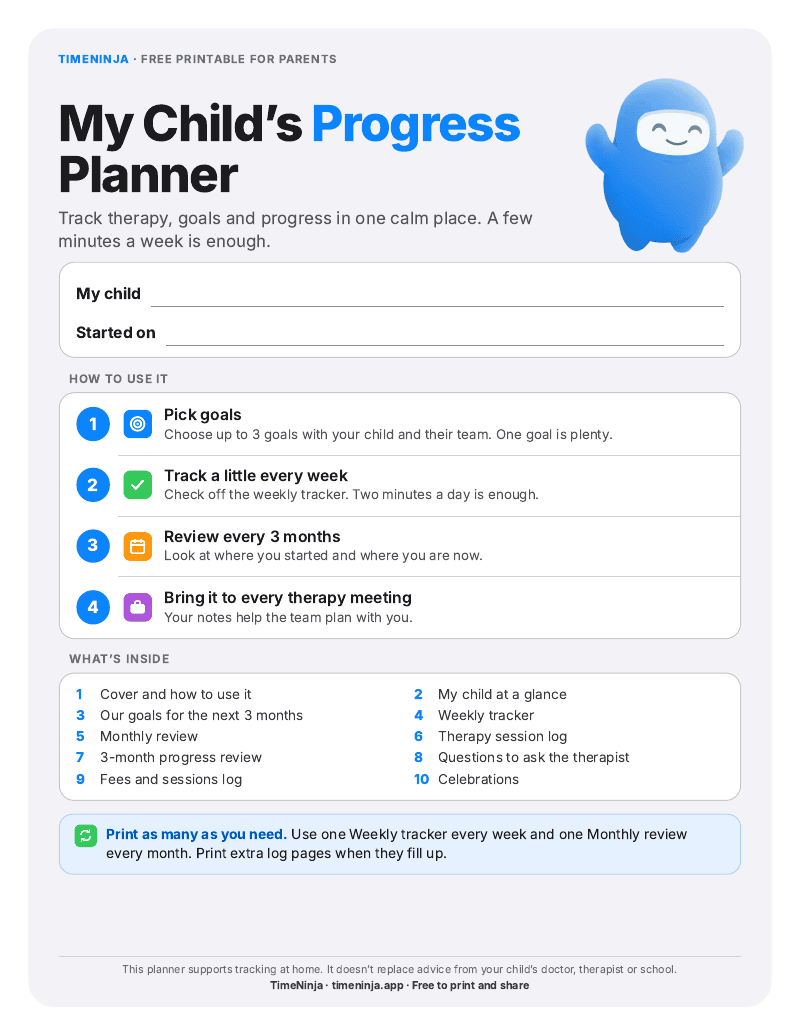
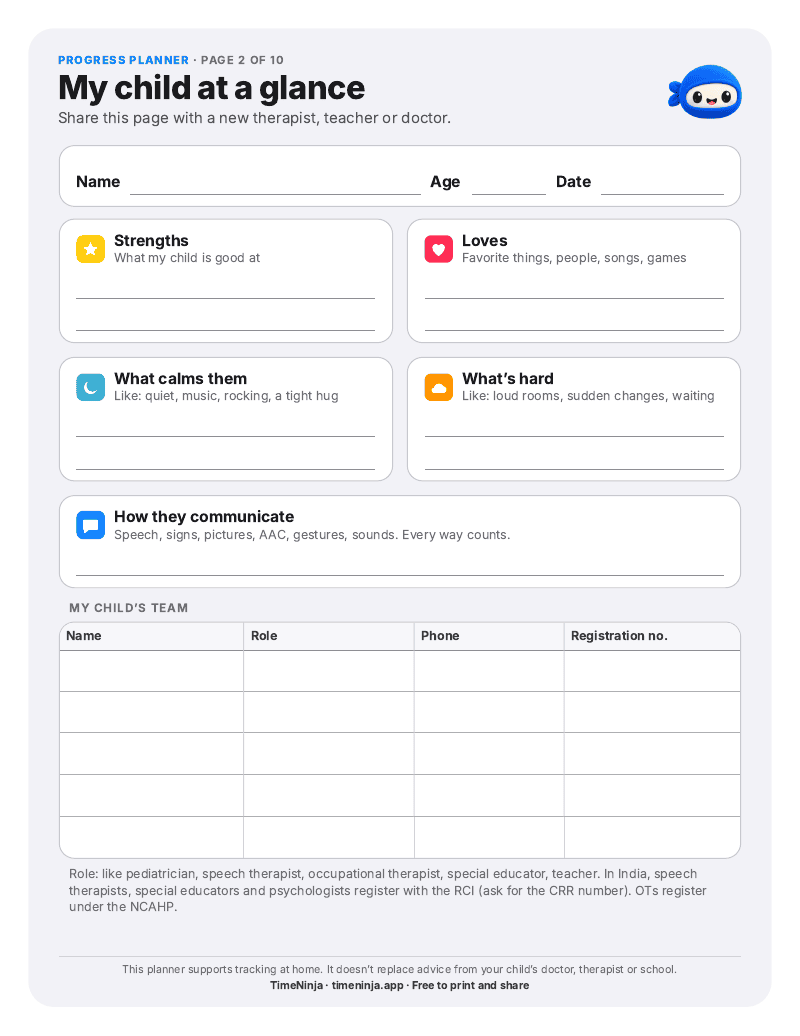
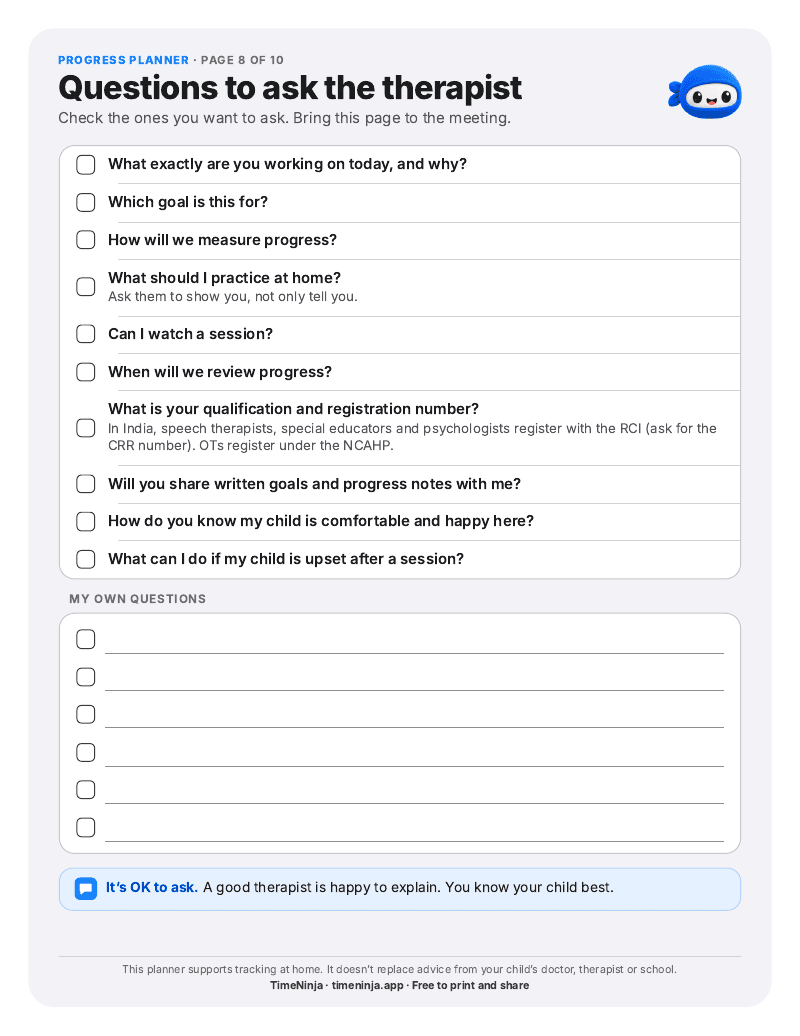
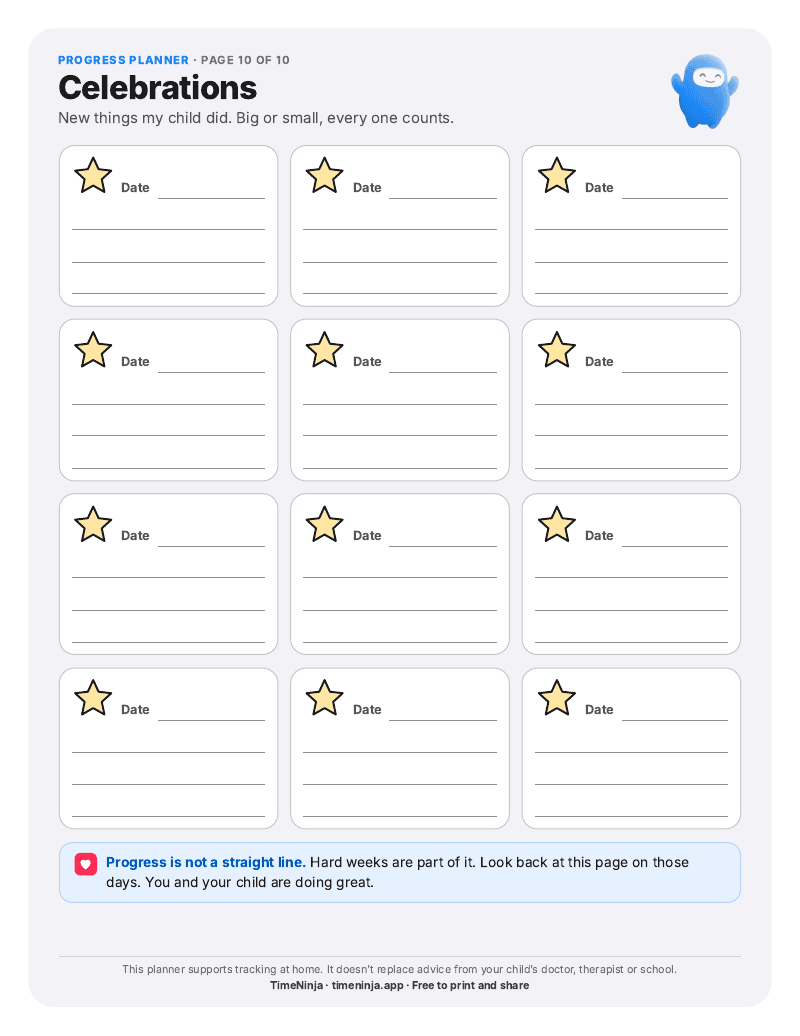
हिंदी में डाउनलोड करें (A4)
यही 10 पेज आसान हिंदी में, A4 पेपर के साइज़ में। मुफ़्त है, कोई साइन-अप नहीं। पूरा लेख भी हिंदी में पढ़ें।
⬇ हिंदी PDF डाउनलोड करें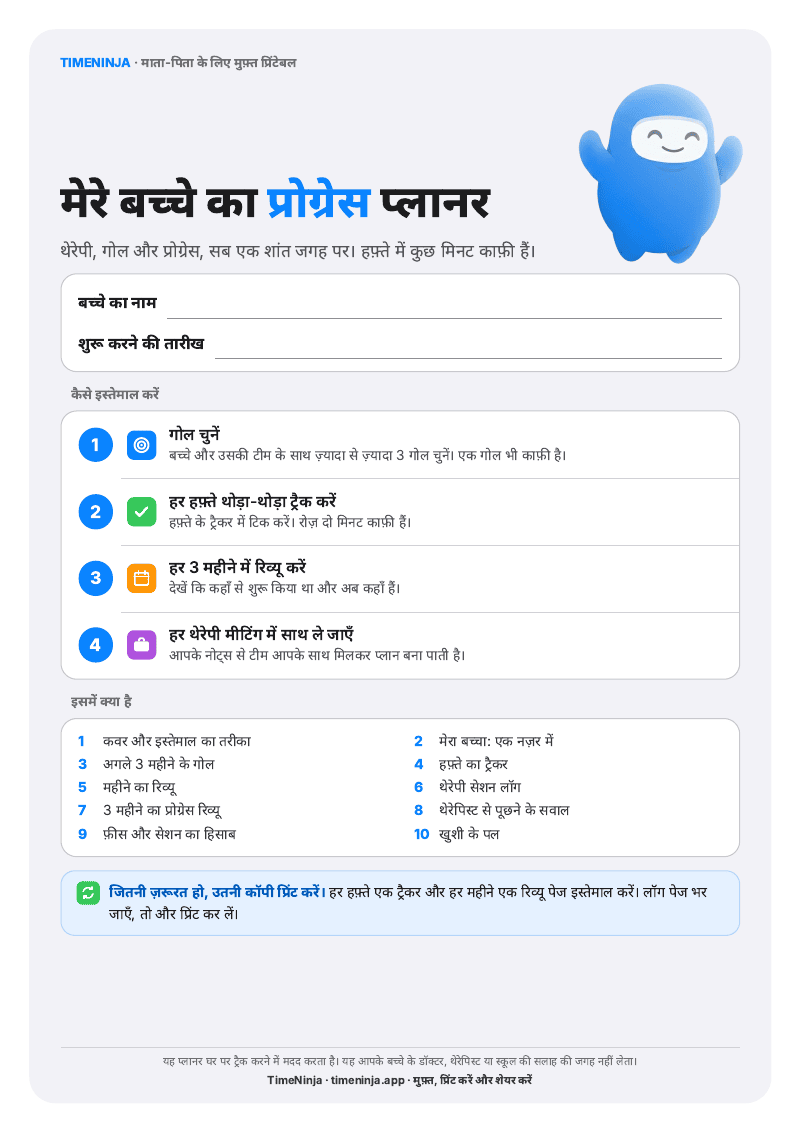
New to autism? Start with our autism in kids guide, which links every topic on this site.
Frequently asked questions
How do I know if my child's therapy is working?
Compare where your child started with where they are now, on 1 to 3 clear goals.
If the numbers have moved, your child needs less help, or the skill shows up at home, therapy is likely helping. If nothing has changed in about 3 months, ask the therapist what they will change.
How often should I track my child's progress?
A few minutes, 2 or 3 times a week, is enough. Do a short review once a month, and a bigger review with the therapist every 3 months.
What is a baseline?
A baseline is a record of what your child does now, before work on a goal starts. Watch for about a week and write it down, for example "asks for more at 0 out of 5 snacks". Without a baseline, it's hard to see change.
What if my child makes no progress in 3 months?
Check the goal, the amount of practice, your child's sleep and health, and the approach. Ask the therapist what they will change. If there are no written goals or data, or nothing changes after a review, think about a second opinion.
Is the Progress Planner free, and is there a Hindi version?
Yes, it's free. It's a 10-page PDF with no sign-up, and you can print as many copies as you need. A Hindi version in A4 size is free too.
Sources
- Bickman L, et al. Effects of routine feedback to clinicians on mental health outcomes of youths: results of a randomized trial. Psychiatric Services, 2011.
- Lambert MJ, Whipple JL, Kleinstäuber M. Collecting and delivering progress feedback: a meta-analysis of routine outcome monitoring. Psychotherapy, 2018.
- American Speech-Language-Hearing Association. Evidence-based practice (EBP).
- Steinbrenner JR, et al. Evidence-based practices for children, youth, and young adults with autism. National Clearinghouse on Autism Evidence and Practice (NCAEP), FPG Child Development Institute, UNC, 2020.
- World Health Organization. Caregiver Skills Training for families of children with developmental delays or disabilities.
- Paruthi S, et al. Recommended amount of sleep for pediatric populations: a consensus statement of the American Academy of Sleep Medicine. J Clin Sleep Med, 2016.
- US Code of Federal Regulations. 34 CFR 300.320, Definition of individualized education program (Legal Information Institute, Cornell Law School).
- American Speech-Language-Hearing Association. Documentation in Schools (Practice Portal).